Call Us:
 Mail Us:
Applying to Turkish Universities: A Complete Guide for International Students (2026)
 By Ammar
- 4 min read

Every year, thousands of international students from Syria, Iraq, Jordan, Palestine, Lebanon, Yemen and across the Arab world choose to study in Turkey — drawn…
Every year, thousands of international students from Syria, Iraq, Jordan, Palestine, Lebanon, Yemen and across the Arab world choose to study in Turkey — drawn by the quality of education, the breadth of programmes, and the international recognition of Turkish degrees. With multiple admission pathways available, the application process for Turkish universities (commonly called mufadalah) is the main gateway for foreign students who want to enrol in bachelor's programmes taught in Turkish or English. This 2026 guide walks through every admission route, the required documents, and step-by-step instructions for a successful application.
What does "Mufadalah" actually mean?
Mufadalah is the process Turkish universities use to evaluate and rank applicants based on a combination of factors: high-school GPA (after equivalency), entrance-exam scores like YÖS or SAT, language certificates, and sometimes an interview. Criteria vary from one university — and even one faculty — to another, so you'll need to read each programme's requirements carefully.
Types of admission routes to Turkish universities
1. Public university applications
Public universities open applications for international students once or twice a year (summer and winter intakes). You'll typically complete an online form on the university's portal and upload scanned documents. Most public universities require either the university's own YÖS exam, an international SAT score, or — increasingly — the centralised TR-YÖS exam.
2. Private (foundation) university applications
Private universities are far more flexible. Applications are usually open year-round, with main intakes in summer and winter. Most accept students based on high-school grades alone, and offer scholarships ranging from 25% to 100% depending on academic record and chosen programme.
3. The centralised TR-YÖS exam
Since 2022 Turkey has run a centralised entrance exam — TR-YÖS — administered by ÖSYM under the higher-education council (YÖK). It's now accepted by most public universities in place of each university's individual YÖS, letting you apply to multiple public universities with a single score.
Main entrance exams
The YÖS exam
YÖS is a Turkish entrance exam designed specifically for foreign students. It tests mathematical reasoning, abstract thinking and basic logic — no Turkish-language ability required to pass. It usually consists of 80 questions and is the main route into competitive fields like medicine, engineering and business. Major public universities like Istanbul, Marmara, Gazi and Ankara still run their own YÖS exams.
The SAT
The SAT is widely accepted by Turkish universities, especially for English-medium programmes. It's an excellent alternative to YÖS — particularly for students from international curricula. Required scores vary by university, but a competitive application typically starts around 1100/1600.
Language certificates: TÖMER, TOEFL & IELTS
For Turkish-medium programmes, you'll need TÖMER at C1 level (or an equivalent). For English-medium programmes, you'll need TOEFL, IELTS, or pass the university's internal English proficiency exam. Students who don't have these certificates can enrol in a one-year preparatory programme (Hazırlık).
Türkiye Bursları — the Turkish government scholarship
Türkiye Bursları is a fully-funded government scholarship offered each year by the Presidency for Turks Abroad and Related Communities (YTB). It covers tuition in full, housing, health insurance, return flights, and a monthly stipend. The application window typically runs January–February through the official portal at turkiyeburslari.gov.tr.
Documents you'll need
- Original high-school diploma with a certified translation and notary (Noter) seal.
- Official transcript (mark sheet) with translation.
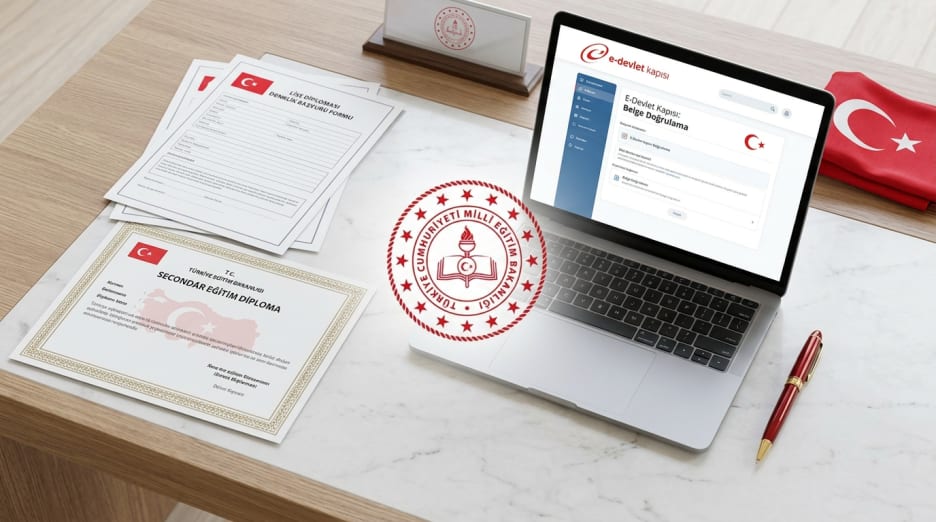
- High-school equivalency certificate (Lise Denkliği) from the Turkish Ministry of Education.
- Valid passport.
- Recent passport-style photos with a white background.
- Language certificate (TÖMER / TOEFL / IELTS) if available.
- YÖS / TR-YÖS / SAT result for public-university applications.
- Proof of financial means for some private universities.
Step-by-step: the 2026 application process
- Pick a university and programme after comparing tuition, scholarship offers, academic ranking and city.
- Prepare your documents early — translation and notary work can take two to four weeks.
- Register for the right exam (TR-YÖS, a university's individual YÖS, or the SAT).
- Submit your application online through the university's portal before the deadline.
- Track your admission decision by email or in your applicant dashboard.
- Pay the initial enrolment fee to confirm your seat.
- Apply for a student visa at the Turkish consulate in your home country with your acceptance letter.
- Register your fingerprint and apply for a student residence permit once you arrive in Turkey.
Tips that actually move the needle
- Apply to several universities to maximise your scholarship offers.
- Re-read each programme's admission criteria every year — minimum GPA cutoffs change frequently.
- Email the university's international students office before applying — most respond within a few days.
- Be sceptical of agencies that charge large sums. Many universities offer free advisory directly to students.
- If your Turkish or English isn't strong yet, budget for a preparatory year in your overall study plan.
Final thoughts
Applying to Turkish universities in 2026 is more streamlined than ever, thanks to fully online portals and the YÖK Atlas tool that lets you compare programmes, tuition fees, and admission criteria side-by-side. Whether you target a top public university through TR-YÖS or a private university with a generous scholarship, what really matters is preparing your documents early, picking the right entrance exam for your profile, and staying disciplined about deadlines. Plan thoroughly, lean on trusted sources, and start your Turkish university journey with confidence.