Call Us:
 Mail Us:
The Literacy Exam in Turkey (2026): Registration, Levels, and What It's Used For
 By Ammar
- 4 min read
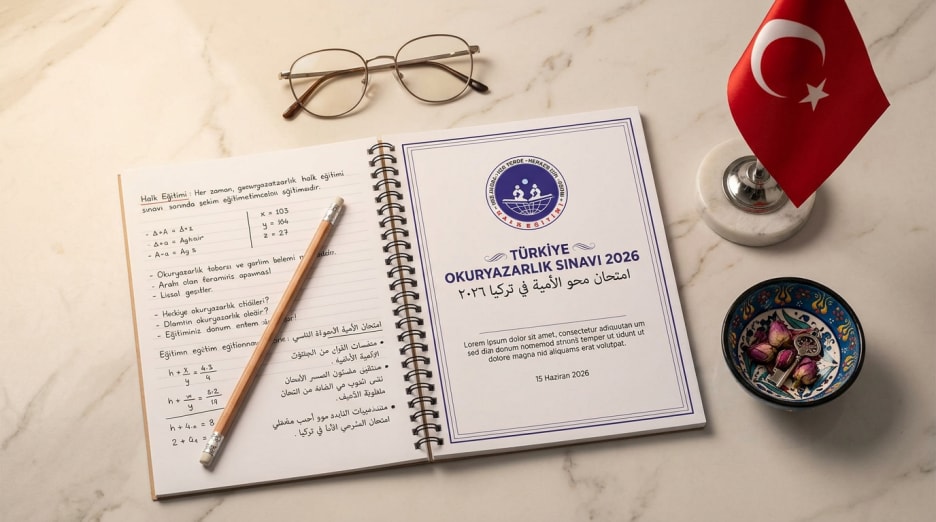
The literacy exam in Turkey (Okuma Yazma Sınavı) is an official test administered by the Turkish Ministry of National Education (MEB) through Halk Eğitim Merke…
The literacy exam in Turkey (Okuma Yazma Sınavı) is an official test administered by the Turkish Ministry of National Education (MEB) through Halk Eğitim Merkezi (HEM) community-education centres. Students who pass receive an officially recognised literacy certificate that's used for several important government procedures — most notably, obtaining a driving licence (for people without a formal school diploma) and registering for open university education. This 2026 guide explains everything you need to know about the exam in detail.
What is the literacy exam?
It's a reading-and-writing test in Turkish, offered by the Ministry of Education to anyone who hasn't completed formal education or doesn't hold any prior school certificate. Its purpose is to verify that a person has basic reading-and-writing ability in Turkish, and it opens the door to an officially recognised certificate inside Turkey.
When do you actually need the literacy certificate?
1. To get a driving licence
You can't get a driving licence in Turkey without an education certificate. If you don't have a recognised primary- or middle-school diploma, the Level 2 literacy certificate is enough to apply for a Class B driving licence (cars).
2. To register for open university education
If you plan to enrol at AÖF or AUZEF and don't have a high-school diploma, you'll first need to earn primary, middle and high-school certificates through Halk Eğitim — the literacy exam is the first rung on that ladder.
3. For certain government and employment paperwork
Some Turkish government services and job applications require proof that you can read and write. The literacy certificate satisfies this requirement in most cases.
The two levels of literacy certification
Level 1 — Birinci Kademe
Covers basic reading and writing: learning letters, forming words and reading simple sentences. It ends with a short exam and doesn't require advanced language skill. Most students complete it in 4 to 8 weeks of part-time study.
Level 2 — İkinci Kademe
This is the official equivalent of a Turkish primary-school certificate. Successful students receive a recognised diploma that qualifies them to apply for a driving licence or to continue education at the middle-school level via Halk Eğitim. It takes a little longer than Level 1 but carries significantly more weight officially.
Where are the classes and exam held?
Classes are held at Halk Eğitim Merkezi (HEM) centres located in every Turkish province. Each province has dozens of branches. You can find the nearest one via:
- The official Ministry of Education website (meb.gov.tr).
- Your provincial directorate of national education (e.g., İstanbul İl Milli Eğitim Müdürlüğü).
- Or e-Devlet — search for "Halk Eğitim Merkezi".
Documents you'll need
- Copy of your passport or Turkish residence permit (Kimlik).
- Two recent passport-style photos with a white background.
- Your foreign ID number (Yabancı Kimlik No).
- Proof of address (faturalı adres belgesi) at some centres.
Registration is normally completely free — it's a government service open to anyone residing in Turkey, regardless of nationality.
Registration step-by-step
- Visit the nearest Halk Eğitim Merkezi in your district.
- Show your personal documents to the registration officer and request enrolment in literacy Level 1 or Level 2.
- You'll be assigned to a class that matches your current level and availability.
- Attend regularly — attendance is sometimes a prerequisite for sitting the final exam.
- Sit the final exam on the date set by the centre.
- Once you pass, you'll receive the official literacy certificate, stamped by the Ministry of Education.
Can you skip the classes and take the exam directly?
Yes — if you're confident you can already read and write Turkish, you can register directly for the Level 2 exam (the primary-school equivalent) at the centre. This is a popular route for Arab students who already speak Turkish fluently and just need the certificate quickly, often to apply for a driving licence.
What's on the exam
The exam includes basic questions on:
- Reading and understanding short Turkish passages.
- Writing words and simple sentences.
- Basic arithmetic: addition, subtraction, multiplication, division.
- General knowledge: country, time, numbers.
What can you do once you've earned the certificate?
After receiving your Level 2 literacy certificate, you can:
- Apply for a Class B driving licence (passenger cars) at any accredited driving school.
- Continue your education toward a middle-school certificate (Ortaokul Diploması) through the same Halk Eğitim system.
- Enrol in vocational courses that require a minimum education level.
- Improve your employment options in Turkey — especially in jobs that involve written communication.
Practical tips
- Always start with a visit to the Halk Eğitim centre in your neighbourhood for accurate, local information — rules can vary slightly between provinces.
- If your Turkish is weak, take a Türkçe course at the same centre before sitting the literacy exam.
- Keep multiple copies of your literacy certificate — it'll be requested for various government procedures.
- The certificate doesn't expire, so you can use it any time after earning it.
Final thoughts
The literacy exam in Turkey is the first door for anyone who wants an officially recognised Turkish education certificate but lacks prior documented schooling. It's free, available in every province, and accredited by the Ministry of Education. In 2026, Halk Eğitim centres are running intensive programmes to serve foreign communities, making the process simpler and faster than ever. Register at your nearest centre, pass the exam, and use your certificate to unlock the driving licence, open-education access, and broader employment opportunities Turkey has to offer.